Residues from Oxalic Vaporization
June 17, 2026
Contents
ACID RESIDUES FOLLOWING OA VAPORIZATIONS. 1
EXAMPLE OF A 1-GRAM OAV “DOSE”. 2
IS THE DOSE PROPORTIONAL TO THE RESIDUES ON THE BEES?. 4
TAKING SOME ACTUAL MEASUREMENTS. 7
Residues from Oxalic Vaporization
Randy Oliver
ScientificBeekeeping.com
First Published in ABJ January 2026
We’ve previously shown how much oxalic acid comes out of a vaporizer, and how rapidly its acidity degrades. So let’s now take a look at the resulting residue levels on the bees after a vaporization application.
ACID RESIDUES FOLLOWING OA VAPORIZATIONS
Now that I’ve covered how we titrate to quantify acid levels, let’s return to oxalic vaporization (we’ll get to dribble, extended-release, and other methods in future articles). Since we’ve shown that only about half the acid load put into a vaporizer actually makes it out as vapor, we need to adjust our concept of what a “dose” is.
The bees in the hive aren’t exposed to oxalic vapor — by the time the cloud gets to them, it’s a fog of microcrystals, which then settles or electrostatically clings to surfaces within the hive. Unlike with formic acid, which can penetrate cell cappings, the oxalic microcrystals only attach to the surfaces of the combs and the bees’ bodies (Figure 1), as well as the woodware.

Fig. 1 Immediately after vaporizing a hive with oxalic acid, the bees look as though they’ve been dusted — which they have! They are covered in tiny sparkling microcrystals of oxalic acid clinging to their “hairs” (setae), as in the lightly dusted bee above. More photos at [[1]].
We’ve found that after a vaporization, the amount of acidity on the bees’ bodies peaks at around 2-3 hours, then rapidly diminishes (by up to 90%) over the next 24 hours — so to quantify the acid residues post vaporization, we perform our titrations at 2-3 hours.
EXAMPLE OF A 1-GRAM OAV “DOSE”
Initially, the EPA-registered dose for Api-Bioxal vaporization was 1 gram of oxalic acid dihydrate per hive, later revised to 1 gram per brood chamber, and revised again in 2025 to 4 grams per brood chamber. (It’s not EPA’s job to confirm efficacy, but only about regulating “unreasonable risk to man or the environment.”)
Anyway, let’s do some math! If we load 1 gram of OA into a vaporizer, and 50% comes out and gets evenly distributed over the entire interior surface area of the hive (ten combs covered with bees + the hive body interior walls + the bottom board and cover), the calculated dose per bee (assuming 2000 bees per comb) comes out to 16µg of OA per bee (based upon the surface area covered by a bee).
To see how that figure jibed with reality, I put 1 gram of OA into a vaporizer, and shot it into single-deep hive in which 8 combs were covered with bees. After 2 hours I plucked a total of 20 bees from various combs, and immediately titrated them (Figure 2). I also scooped a half cup of bees, and titrated them as a batch (Figure 3).

Fig. 2 Results of individual-bee titrations 2 hours after vaporization of a hive with 1 gram of oxalic acid. Note that in any hive, no matter the method by which the oxalic acid has been applied, we always see a great degree of bee-to-bee variation in the amount of acid residues, as indicated by the color change toward yellow (ranging in the photo above from zero to 26 µg). Note: In these articles the amount of acidity is given in oxalic acid dihydrate equivalents.
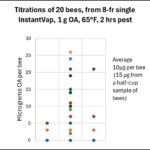
Fig. 3 The average residue level for the 20 bees was 10 µg. On the other hand, the half-cup of bees titrated nearly exactly (15 µg) with the theoretical expected dose per bee of 16 µg. These titrations suggest that by 2 hours, the bees have transferred most of the oxalic acid that condensed in the hive onto their bodies (including their feet). They also give us a baseline for calculations.
IS THE DOSE PROPORTIONAL TO THE RESIDUES ON THE BEES?
One could assume that doubling the dose of OA applied to a hive would double the dose winding up on the bees — but you likely know how I feel about unverified assumptions. We happened to have on hand a group of 11 double-deep hives that had not been treated with oxalic acid (confirmed by titrating a half cup of bees from each hive in advance). So we randomly assigned five different OA application methods to two hives per treatment group:
- 2 g OA in 5% glycerin dribble
- 2 g OA in 50% sugar dribble
- 2 g OA vaporization
- 4 g OA vaporization
- 8 g OA vaporization
And what the heck — since there was one hive left over, and as I happened to have some rhubarb stalks on hand, I crushed the stalks in order to answer the question of whether it would be efficacious to treat one’s hives with rhubarb (Figure 4).

Fig. 4 I pounded the stalks with a kitchen mallet to release the oxalic-laden juices and placed them onto waxed “pickups” to avoid the juice being absorbed by the top bars. The next day (by which time the sap had dried) I removed the paper to expose the stalks fully to the bees for chewing (which they didn’t do)
We then performed titrations of half-cups of bees at 2 and 24-hours, 4 and 14 days to compare the OA residue levels (Figure 5).
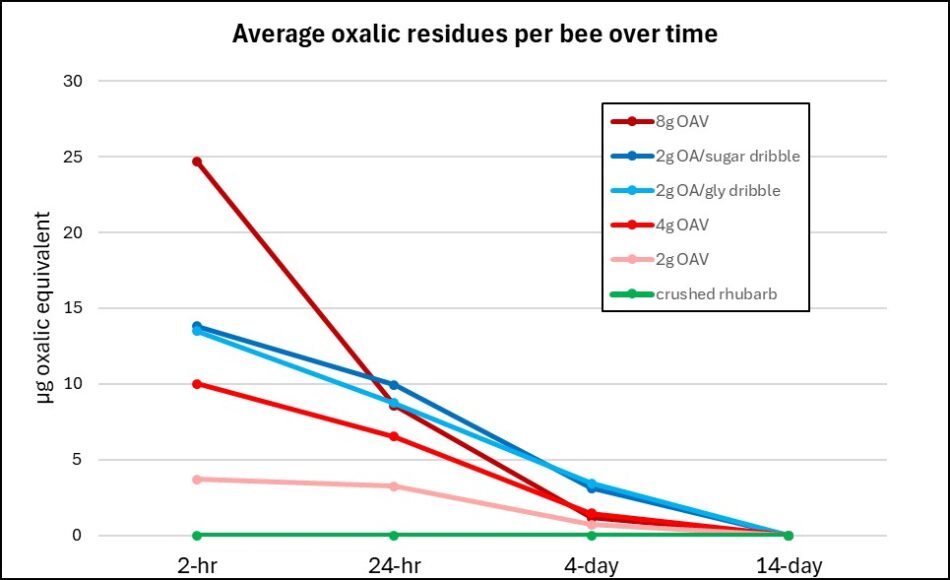
Fig. 5 Since the results from each pair of hives were fairly consistent, I averaged them. As you can see, the acidity on the bees was directly proportional to the doses applied via vaporization. But note that the residues from the dribbles were still disproportionately higher than those applied by vaporization, as well as being more persistent.
Practical application: The above is consistent with Hasan Al Toufalia’s finding [2] that OA dribble was as efficacious at twice the dose applied via vapor — not surprising, since we now know that only half the OA load put into a vaporizer comes out intact (so the residues from 4 grams applied by vaporization would be expected to be roughly equal to those from a 2-gram dribble). But it is of interest that dribbles with either sugar or glycerin also did a better job at maintaining their acidity (and presumably efficacy against the mite). And oh, it looks like you may as well save your rhubarb for pies!
NOTE: Take the above numbers with a grain of salt. We’re experimenting with titrating half-cups of bees, since it gives an average for ~ 315 bees, is quick, and the bees are unharmed. But we’re also finding that individual titrations of 10-20 bees may be more informative (as far as the bee-to-bee distribution of acidity), and may not always reflect the half-cup results (I suspect that we’re leaving a lot of acid remaining on bees after the single rinse). Both Figure 3, and as we’ll see further down, individual-bee titrations, showed much higher residue values for 4-gram OAVs than the figures above.
That said, although I question the absolute values above, I feel that the comparative values between the treatment groups in this experiment are likely valid.
SO HOW MUCH OA TO USE?
Although the research papers cited below found no adverse effects from oxalic acid vaporization (OAV) upon the colonies, keep in mind that in my incubator trial last month, OA can indeed be harmful to bees that get hit with a high dose, so we don’t want to apply a higher amount of acid than absolutely necessary. Update: A group in Canada [[2]] tracked the effects of four weekly vaporizations with either 0, 5, 10 or 20 g of OA. Although, they concluded that there were “no significant short-term nor long-term, negative effects on colony or queen health,” I suggest that you evaluate their figures yourself.
For Broodless Colonies
Al Toufailia found that high efficacy is attained from a 1-2-gram dose (applied by vaporization) for a broodless single [[3]], and that a 2.2 g dose didn’t appear to harm the bees (that would extrapolate to a 4-gram dose for a broodless colony in double brood chamber.
For Colonies with Brood
It appears that you may need to hit a colony containing brood a little harder. Cameron Jack ran a trial that indicated that 3-4 grams per brood chamber (applied by vaporization) are required for hives containing brood [[4]](which still required repeated vaporizations to attain good efficacy) [[5]]. Thus many beekeepers are applying up to 8-gram doses to strong colonies for summer treatment (this seems excessive to me, and I am currently investigating).
Using the same math as above, a 3-4-gram dose of OAV would theoretically result in an applied average dose of 16 x 4 = 50-64 mg per bee. So let’s see how closely theory matches reality!
Where the Rubber Hits the Road
After wrapping up our investigations into the output of vaporizers, we were curious as to how much of that vaporized oxalic acid actually winds up on the bees’ bodies (and perhaps the bodies of the mites). So in mid-January, we went to one of our outyards and identified colonies that had not been treated with OA (confirmed by titration). We then applied 4-gram (in the form of EZ-OX tablets) OA vaporizations (2 grams per brood chamber) to double-deep hives, using either an InstantVap, Provap110, or Varrox vaporizer, in order to see what sort of acid residue levels we’d find on the bees two hours post application (Figures 6 & 7).

Fig. 6 Two hours after applying an OAV, I’d pluck 10 bees from the outer comb, then from an intermediate comb, and finally from the center comb of the cluster, and drop each individual bee into a test tube containing the indicator solution for titration.

Fig. 7 My assistant Rose then immediately titrated each bee.
Based upon Figure 3, a 4-gram dose would be expected to result in ~30 µg/ bee, but from Figure 5, only 10 µg/ bee. So let’s take a look at what we found.
PROVAP 110
This vaporizer required AC current, so I ran it off a voltage inverter hooked to our truck battery (Figure 8). We used the factory setpoint temperature of 230°C.

Fig. 8 We used bent wedges of corrugated cardboard to seal the entrances during our vaporizations, and applied 4 grams of OA to each hive, spacing out our timing so that we could perform our titrations two hours later. The titration results for each of three replicate hives are shown in Figures 9 & 10.


Fig. 9 Here are each hive’s titrations for the Provap110, to show the degree of hive-to-hive variation typical for all the vaporizers. Each colored dot represents the amount of acidity for an individual bee (10 bees in each column, several often overlapping).
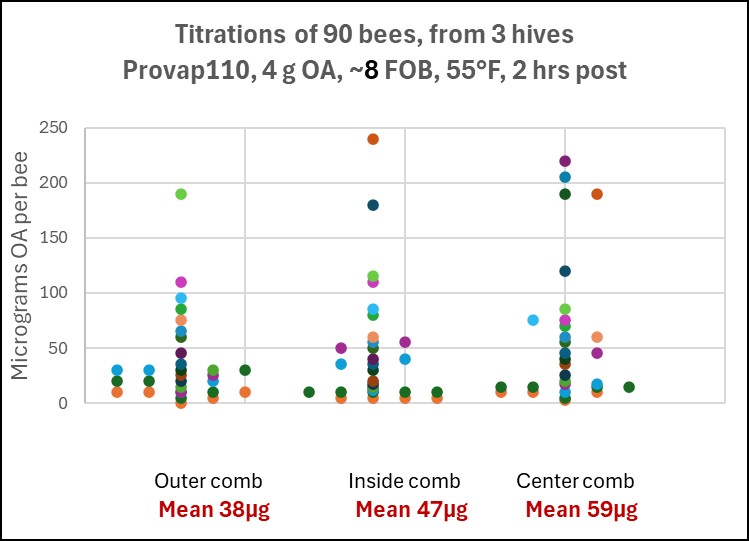
Fig. 10 Here’s the combined data for all three hives, jiggled to minimize the overlap for all 90 sampled bees. It came as a surprise to us that, two hours after applying the vapor, the bees taken from the center comb of the upper brood chambers had higher amounts of acidity on their bodies than did the bees at the outside of the cluster.
Practical application: Despite being hit with a fog of oxalic crystals, note the large bee-to-bee variation in acid residues, ranging from zero to nearly 250 mg. How this amount of variation (which we observe with every type of OA application method) affects a treatment’s efficacy against varroa is a subject for further research!
The overall average was 48 mg per bee – not far from the expected theoretical dose, and clearly enough to kill most of the exposed mites (those not hidden under the cappings in the brood).
INSTANTVAP
The InstantVap runs off rechargeable batteries, so is handy for outyards (Figure 11). We again used the recommended setpoint temperature of 230°C.

Fig. 11 It takes a goodly amount of power to vaporize OA, so carry spare batteries for an InstantVap! Results in Figure 12.
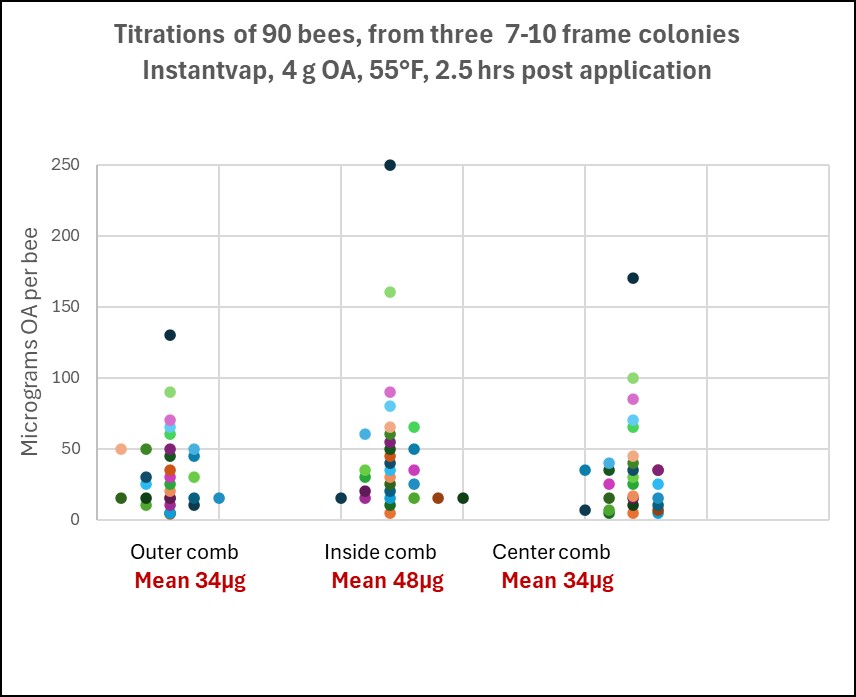
Fig. 12 The InstantVap vaporizations resulted in fairly consistent residues. The overall average was 39 mg per bee.
To answer a question that I often get, we also performed a vaporization on a hive with a screened bottom board (1/8” hardware cloth) (Figure 13).

Fig. 13 Since we saw some of the OA fog escaping from the screened floor of the hive, we weren’t surprised that the overall average OA residue level was only 19 mg per bee (compared to 39 mg for the hives with solid bottoms).
Practical application: For best results, minimize the escape of the OA fog by sealing the hive, including an open-mesh floor.
VARROX
The Varrox is the original pan-type vaporizer, runs off a car battery, and takes several minutes per cycle. The resulting residue levels were again remarkably consistent (Figures 14 & 15).

Fig. 14 For the Varrox, the overall average was 41 mg per bee (almost exactly the same as with the InstantVap). Oddly, the bees from the comb directly above the vaporization pad had the lowest residue levels, go figure!
Practical application: Don’t forget to unhook the Varrox from the battery once vaporization is over, since it can burn a wooden bottom board and smoke out the bees! (Yes, I learned this the hard way — on a hive not in this trial.)

Fig. 15 Yes, we also ran a separate rep of the Varrox on a screened bottom board. Here you can see some of the fog escaping. And yes, a screened floor again reduced the amount of OA residues on the bees (Figure 16).
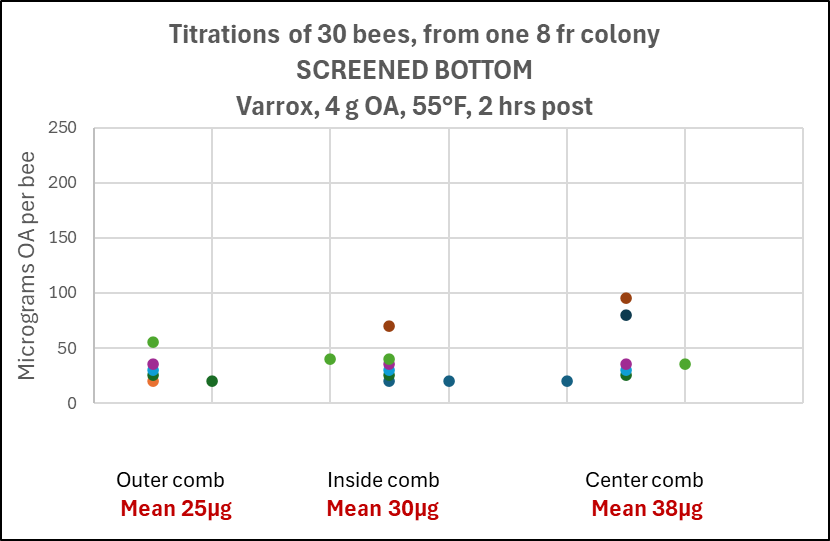
Fig. 16 The overall average was 31 mg per bee — (compared to 41 mg for the solid bottoms).
CONCLUSIONS
- Only a small proportion of the oxalic acid that you load into a vaporizer ever winds up on the bees.
- That said, that’s still a lot of strong acid on their bodies!
- Honey bees, and their colonies, have a surprisingly high tolerance for oxalic acid.
- Given loads of 4 grams of oxalic acid, the resulting residues from all three of the tested vaporizers were similar, and in a range that should result in good efficacy against exposed mites (48, 39, and 41 mg average per bee).
- However, since those residues rapidly lose their acidity, for good efficacy you need to perform repeated vaporizations when brood is present (a subject that I’ll be covering in the future — stay tuned!).
ACKNOWLEDGEMENTS
Thanks to all of you whose support makes our research possible. And to my dedicated helpers Rose Pasetes and Corrine Jones.
CITATIONS
[1] https://scientificbeekeeping.com/oxalic-crystals-on-bees-after-vaporization/
[2] Tellarini Prieto, E, et al (2024) Safety assessment of high doses of vaporized oxalic acid on honey bee worker health and queen quality. Frontiers in Bee Science 2: 1442030.
[3] Al Toufailia, H, et al (2015) Towards integrated control of varroa: 2) comparing application methods and doses of oxalic acid on the mortality of phoretic Varroa destructor mites and their honey bee hosts. Journal of Apicultural Research 54(2): 108-120.
[4] Jack, C, et al (2020) Evaluating the efficacy of oxalic acid vaporization and brood interruption in controlling the honey bee pest Varroa destructor (Acari: Varroidae). Journal of Economic Entomology 113: 582–588 https://doi.org/10.1093/jee/toz358
[5] Prouty, C et al. (2023) Oxalic acid application method and treatment intervals for reduction of Varroa destructor (Mesostigmata: Varroidae) populations in Apis mellifera (Hymenoptera: Apidae) colonies. J Insect Sci 23: 13 https://doi.org/10.1093/jisesa/iead086