Testing Varroxsan: Part 1
June 17, 2026
Contents
A NOTE ON MITE REDUCTION VS. EFFICACY OF TREATMENT 2
MY OWN ANALYSIS OF THEIR RESULTS. 3
MY ANALYSIS OF THEIR RESULTS. 4
WE DON’T NEED NO STINKIN’ SCIENTISTS! 4
TIPS FOR RUNNING A FIELD TRIAL. 4
TWO FIELD TRIALS FROM THE SOUTHEASTBOB’S AND GREG’S TRIALS. 5
MY OWN TRIAL IN THE CALIFORNIA FOOTHILLS. 8
EFFECT UPON THE MITE INFESTATION LEVEL. 17
DID EFFICACY CORRELATE WITH THE ACIDITY ON THE BEES?. 18
Testing Varroxsan
Part 1
Randy Oliver
ScientificBeekeeping.com
First Published in ABJ in April 2026
I published my first article about extended-release oxalic acid (OAE) for mite control over nine years ago [[1]], but it took until last year for the first registered product, VarroxSan, to finally hit the U.S. market. So how does it compare to other extended-OA treatments?
I’ve done a lot of research on potential treatments for varroa control, favoring “natural” biopesticides that don’t problematically contaminate our combs and honey (and are likely more sustainable). Extended-release oxalic acid (OAE) stands out as one of our best options (to be used in rotation with other treatments). But I leave it to others to go through the onerous and expensive registration process to bring them to market. So I was very happy to see the registration of VarroxSan strips (and am in regular contact with two other beekeepers who are currently in the tedious registration process of additional OAE products).
SO HOW WELL DOES IT WORK?
I can find only a single published scientific field trial of VarroxSan, by Branchiccela in Uruguay [[2]], using Africanized bees. Their team ran three separate trials over the course of several years, each for 42 days, all in hives consisting of a single Langstroth brood box with a honey super above (additional supers in the spring trial). In their winter trial, they tested 4 hung VarroxSan strips (the label dosage for a strong single). For the spring trial, they also added a “boosted” group that received an additional 2 strips after 20 days (the boost was added since during this run the colonies nibbled the strips). For their autumn trial they tested three different doses of VarroxSan (3, 4, or 5 strips), as well as 4 strips placed “above” the broodnest (I assume that meant laid flat across the top bars of the brood box). In all three trials they included an untreated negative Control group.
A Note on Mite Reduction vs. Efficacy of Treatment
It’s easy to calculate the degree of reduction of the mite infestation rate by taking before and after mite wash counts, but that doesn’t tell you the efficacy of the treatment, because it doesn’t account for how much the count would have increased if you hadn’t treated. So to calculate efficacy, you need to include an untreated Control group.
Example: At the “normal” rate of mite reproduction, you’d expect the infestation rate of an untreated non-resistant colony to double in a month. So if a treatment only held the count steady (no reduction), it would still calculate out at 50% efficacy. That clarified, I did a reanalysis of their data.
They had calculated efficacies by comparing the total mite drop count during treatment to that from a post-treatment application of synthetic miticides. But that is not how we beekeepers typically judge the result of a treatment, so from their data I recalculated efficacies (using the Henderson-Tilton equation [[3]]), based upon the colonies’ starting and ending mite wash counts (Figure x).I can find only a single published scientific field trial of VarroxSan, by Branchiccela in Uruguay [[4]]. They ran three trials in hives consisting of a single Langstroth brood box, with a honey super above (additional supers in the spring trial). The trials were run for 42 days above stickyboards (counting all fallen mites), at which time flumethrin/amitraz strips were added to kill any remaining mites. “The difference between the remainder mites fallen during the follow-up treatment period and the dead mites fallen during the OA treatment allowed [us] to calculate the OA efficacy.”
They also ran a fourth field experiment for three years to “analyze the consequences of OA treatment in colonies with different initial infestation rates of [mites],” in total taking 293 pre- and post-treatment mite wash counts.
Their Conclusions
They concluded that: “[VarroxSan’s] efficacy depends on the time of the year it is applied, the dose, and the method of administration.” They also found that there was no noticeable effect from VarroxSan treatment upon the adult or brood populations of the colonies, nor any queen losses.
The sole conclusion that they drew from their extensive fourth study was that “higher infestation levels before the experiment correlated with higher infestation levels after the OA treatment” – this stunning finding suggesting that their OA treatments didn’t zero-out many mite infestations (surprising to me, since we regularly see oxalic sponges zero out the mites).
My Own Analysis of their Results
Their trials were all run in hives with relatively low infestation rates (average half-cup mite wash counts equivalents in the 3-9 mite range). Since beekeepers typically check performance of a treatment by mite wash counts, I used a different method to calculate efficacy than they did [[5]], based upon their before and after mite wash numbers (Figures 1 & 2).

Fig. 1 Branchiccela‘s team ran three separate trials over the course of several years, with the winter treatment showing the highest efficacy. For the spring treatment, due to nibbling of the strips, they added 2 additional strips at Day 20 to the “boosted” hives. In autumn, they also tested three levels of doses of hung strips, as well as 4 strips applied “above the brood box” (I’m guessing laid flat, since they labeled the hung strips with the suffix “ins”). Note: due to the low starting infestation rates in all trials, take the efficacy figures as ballpark approximations.
Practical application: The efficacy figures look impressive! But efficacy and mite reduction are two different animals. Efficacy compares the change in mite counts in the treated Test group, compared to that of the increase that took place in the Control group. Since the mite infestation rate typically doubles each month, a treatment that merely held the mite count steady for 42 days would still calculate out to 64% efficacy. Mite reduction just looks at before and after counts, and doesn’t require a control group. So although the spring treatment with 4 hung strips worked out to 68% efficacy, that meant that it really didn’t decrease the infestation rate to any extent.
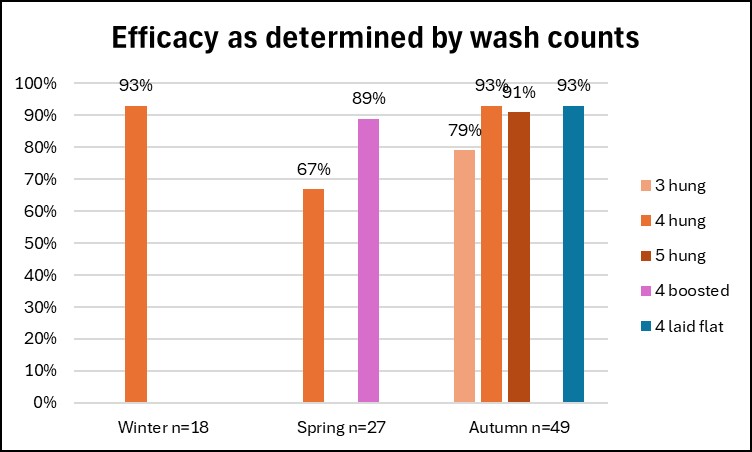
Fig. 2 Their starting wash counts averaged only around 3-8 mites, so the figures above are only rough estimates. Mite wash counts were reduced by all treatments (save for in spring, when the hung strips only held the count steady). For the spring treatment, due to nibbling of the strips, they added 2 additional strips at Day 20 to the “boosted” hives (which, to no surprise, improved efficacy). In autumn, beside the 4 hung-strip dose, they tested a range of doses and application methods.
Takeaways: The efficacies that they obtained were impressive! Note that they got same efficacy from laid-flat strips as they got from hung strips! And that efficacy was less at the dose of 3 hung strips, but didn’t improve with 5 strips.
Their Conclusions
They observed no noticeable effect from VarroxSan treatment upon the adult or brood populations of the colonies, and concluded that: “[VarroxSan’s] efficacy depends on the time of the year it is applied, the dose, and the method of administration.”
My Analysis of their Results
VarroxSan appeared to be most efficacious at reducing the mite level when applied during autumn or winter. Springtime application did not reduce mite levels, but did keep them from increasing (that efficacy was increased by applying a second half dose after 20 days).
WE DON’T NEED NO STINKIN’ SCIENTISTS!
But we beekeepers don’t necessarily have to depend upon institutional scientists for field testing – the whole reason I started writing these articles was to encourage other beekeepers to do their own properly designed research and then share their results.
TIPS FOR RUNNING A FIELD TRIAL
- Define the specific research question you want to answer. Spend a lot of time on this step!
- Make up dummy charts of how you plan to present your results, and work backwards from there (this will show you what data to collect). Anticipate in advance any way that someone could criticize your methodology or analysis.
- Run a comparative Control group along with your Test group(s).
- Include a large enough number of colonies in a trial (the “n”) to allow statistical comparison between the results from each test group and the Controls. Due (due to ingrained colony-to-colony variability, this typically requires at least a dozen hives per treatmenttest group.).
- Start with colonies of similar condition, in the same yard (or yards) in order to minimize variables, and assign the treatments randomly. Treat all the colonies exactly the same, other than the variable of the treatment(s) that you are testing.
- Record every detail of the colonies and hives used, dates, weather, bloom, etc.
- Take and record starting and ending (and perhaps midpoint) data (mite wash count, colony weight, colony strength) relevant to answering your question. If you’ve run a Control group, I suggest using the Henderson-Tilton formula to calculate treatment efficacy [[6]]. If relevant, download my calculator to compute efficacy [[7]].
TWO FIELD TRIALS FROM THE SOUTHEAST
I’m very happy that three beekeepers Greg Rogers, Scott Davis, and Bob Binnie independently ran field trials in 2025, and have allowed me to share their results [[8]]. Let’s start with the results of Greg’s trial, run in North Carolina for 90 days (mid-May through mid-August) with 87 hives (in 8 different locations). (Figure x).two of their own 2025 field trials, performed in the Southeast [[9]]. Both trials were intended to answer the question: “Which OAE treatment and application method, when applied to hives of the stock(s) that I’m running, will result in the lowest increase in mite counts during the May through August treatment?” They started their trials with colonies exhibiting mite counts in the 0-1 range, and measured them again after 3 months. Uh-oh…
Note: “The label is the law”. VarroxSan’s label specifies: “Treat once the infestation reaches 1-2%” (a wash count of 3-6 mites), indicating that VarroxSan is registered solely to reduce an established infestation, not as a preventative treatment. But Bob, Greg (and I) feel that it is a best management practice to proactively keep your mite counts down to zero in the springtime. Don’t you hate how the EPA keeps putting us into the position of being scofflaws?
Greg and Bob graphed out their results in Figures 3 and 4.

Fig. 3 Of interest is the difference between mite control by VarroxSan in Greg’s yards and Scott’s (I’ve found that OAE treatment works best in yards with no mite immigration, but do not know whether that was a factor, nor whether there was a difference in bee stock or weather conditions).
Analysis: There wasn’t much difference in the results from the three treatments to the right. Greg didn’t run a control group, so we can’t calculate efficacy, but we can estimate it (assuming that he started with mite counts of 1). Since a mite population typically doubles each month, we would expect his mite wash counts to increase by a factor of about 8. So although the average counts in the the three treatments to the right went up to 4 (no reduction), that still suggests an efficacy of around 50%. Greg Rogers ran his trial in North Carolina with 87 hives (in 8 different locations), for 90 days (mid-May through mid-August). Although there was no Control group, if we were to assume that his starting counts were 1, after 90 days of “normal” rate of increase, we’d expect them to double three times, to counts of 8. So the three treatments to the right would calc out to about 50% efficacy.
Bob Binnie ran his trial with 811 hives in Georgia, using a variety of mite-resistant bee stocks (likely why his ending mite wash counts were lower than Greg’s). All hives started with wash counts of zero in May (see note), with final washes performed at the end of July and beginning of August.
Note: The label is the law! VarroxSan’s label specifies: “Treat once the infestation reaches 1-2%” (a wash count of 3-6 mites), indicating that VarroxSan is registered solely to reduce an established infestation, not as a preventative treatment. But many of us would agree that keeping your mite counts close to zero in the spring is a Best Management Practice. Once again, the EPA is behind the curve, and forcing us to be pesticide scofflaws.

Fig. 4 Bob did run a Control group, but both it and the other Test groups consisted largely of mite-resistant stock (an additional variable). This may be why there was so little difference in mite increase between his treated and untreated colonies. Since there are no error bars on this graph (to see the range of variation for each group), his collaborators will need to tease out is the effect of each queen stock (see [[10]]) from the effect of each treatment. Bob Binnie ran his trial with 811 hives in Georgia, using a variety of mite-resistant bee stocks (likely why his ending mite wash counts were lower than Greg’s). All hives started with wash counts of zero in May, with final washes performed at the end of July and beginning of August. My seat-of-the-pants estimate (since you can’t perform an efficacy calculation starting from zero) is that efficacies of Bob’s treatments were in the same ballpark as Greg’s, but with the complication that mite-resistant stock was involved. The one standout is the great performance of the Swedish sponges!
Analysis: Of interest is that there was again little difference between Varroxsan hung or laid flat. And that the best performers appeared to be the Swedish sponges (he used a 55% oxalic x 45% glycerin formulation) and the Canadian strips.
Bob and Greg both ran great trials (with large “n’s”), to answer the question: “Which treatment and application method, when applied to hives of the stock(s) that I’m running, will result in the least mite increase between May and August?” So Bob started with mite counts of zero, and followed up with ending wash counts, to measure the degree of increase (from the graph, we’re unable to see in how many hives the mite count didn’t increase at all).”, which should allow his collaborators to tease out whether there were statistical differences between the groups (there are no error bars on their graphs, so we can’t yet tell).
Neither of these trials were designed to see whether the treatments could reduce a mite infestation (you can’t measure reduction when starting with a count of zero). But I’m surprised that the average counts of the treated colonies all went up as much as they did, suggesting that OAE may not work as well in the Southeast as it does in California (this may have to do with humidity).
Neither of these trials were designed to see whether the treatments could reduce a mite infestation (since you can’t reduce from a starting mite count of zero), nor to necessarily calculate efficacy (Greg’s trial lacked a Control group). Nor were their trials designed to easily tease out the effect of some colonies being innately mite-resistant (Bob’s Control group consisted largely of GWB semi-resistant stock). I am in no way criticizing either trial, since they appear to have answered their question nicely, and fulfilled their practical application.
The takeaways from these two trials (and their discussions on video) were:
- VarroxSan laid flat across the top bars appeared to perform about the same when hung. performed nearly as well as hung strips!
- The yet-unregistered Canadian strips appeared to be possibly a bit perhaps more efficacious than VarroxSan.
- Home-made sponges on the top bars appear to be the most efficacious.Home-made sponges on the top bars didn’t maintain zeroes in all hives, but came in First Place.
- What worked best was a combination of resistant stock plus treatment [[11]].
- There may be an effect from high humidity (when I checked weather history, Greg’s North Carolina yards got more rainfall than did Bob’s in Georgia).
- What worked best was a combination of resistant stock plus treatment.
MY OWN TRIAL IN THE CALIFORNIA FOOTHILLS
Because a number of beekeepers had asked me questions about VarroxSan, and since there was so little published research, I realized that I’d need to test the product myself in order to answer them. Not knowing that Bob and Greg were running trials, I it so happened that I was concurrently doing some preliminary research in preparation for running a trial of my own.
Practical application: Prior to running a large field trial, scientists generally perform “quick and dirty” preliminary research to explore possibilities, and to “work out the bugs,” before moving on to more expensive trials from which they might extract statistically significant results. I consider most of the research that I do to be preliminary research, intended to encourage other institutional researchers or product developers to follow up on (I’m often contacted by those that do).
In this case, I was investigating whether I could answer three different questions.
my questions
- Main question: How do the relative amounts of oxalic acid residues on the bee’ bodies during treatment with VarroxSan (as determined by titration) compare to those from sponges or Canadian strips?
- Will laying VarroxSan strips across the top bars (to save installation time) affect their distribution of OA onto the bees?
- How does mite reduction from application of oxalic acid by VarroxSan compare to that by the other treatments?
trial setup
In order to quantify whether a treatment will result in reducing the mite infestation rate, you need to start with hives exhibiting fairly high mite counts. So in March, I set up a yard with 25 nucs made with second-year queens, and didn’t apply any treatments to the colonies as they built up. But although one showed a record wash count of over 400 mites in early July (and was not included in the trial), danged if many of them still exhibited low mite wash counts! By then my sons had already applied oxalic treatments to any non-breeder hives in their operation – this limited the number of hives available for my trial (since I couldn’t bring in hives that had already been treated with OA).
Experimental problem: Similar as with what occurred in Bob’s trial, when you run mite-resistant stock, you can’t assume that the mite infestation will indeed increase in untreated hives. I know ― what a great problem to have!
Anyway, by early July, all the colonies had grown to fill double- or triple-deeps, so we assigned treatments in a randomized block design (so that each test group got hives with similar starting mite counts and colony strengths) (Table 1).
Table 1. By July there were only 15 colonies suitable for a comparative trial, so we were limited to placing only 3 colonies in each of 5 test groups, and didn’t run an untreated Control group. Note that although all three full treatments are in the 50-gram range, the full VarroxSan treatment contains the most oxalic acid. I made the difficult decision to replace my intended test group of 4 hung VarroxSan with a test of the Canadian strips.
I’ll go through what we did photo by photo (Figures 5 – 11).

Fig. 5 Assisted by my helpers Rose and Corrine, we applied VarroxSan per the label instructions of 1 strip per every 2.5 frames of bees (we adjusted each hung strip treatment to the cluster size, erring, if there was a question, on the heavy side) so a few colonies got 1 less than the full number of strips.
For the 4 Canadian strips (not shown), we placed them equally spaced in the brood area – typically 2 in each chamber.
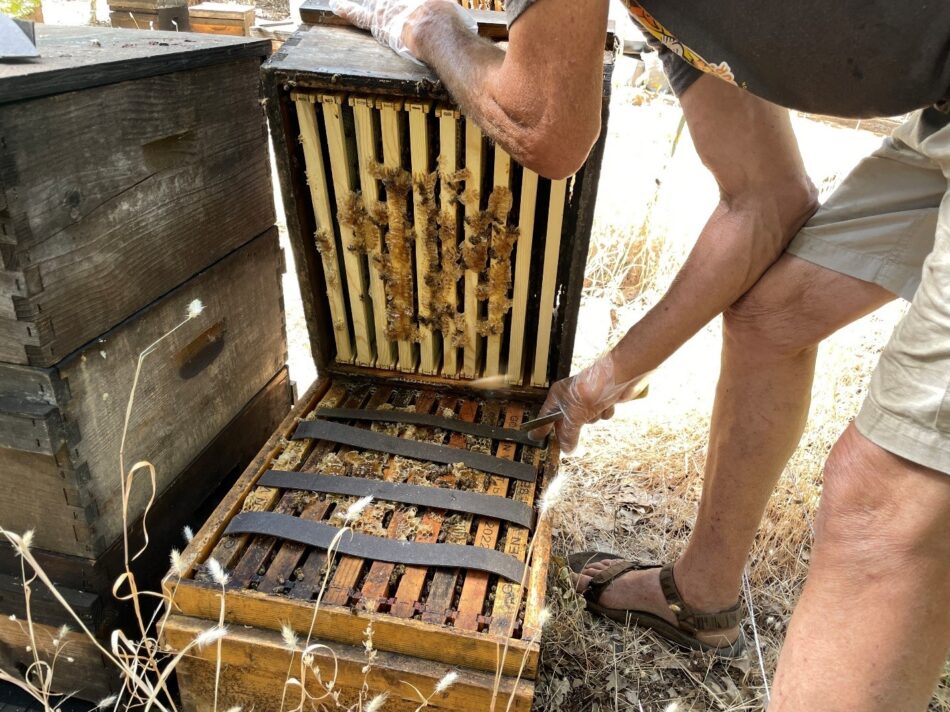
Fig. 6 We placed the flat-laid VarroxSan strips across the top bars between the brood boxes for the 4-strip treatment, as well as above the upper brood box for the 8-strip application.

Fig. 7 We placed the sponges front and rear between the two brood boxes.

Fig. 8 Some colonies chewed the VarroxSan strips (especially those laid flat), others didn’t.

Fig. 9 All the colonies chewed the Canadian strips, dumping highly acidic shreds in front of the hive. The transport of these acidic shreds may help to disperse the acid through the hive, but also remove a lot of acid from the hive. However, we beekeepers benefit from the bees doing the removal of the spent strips for us.
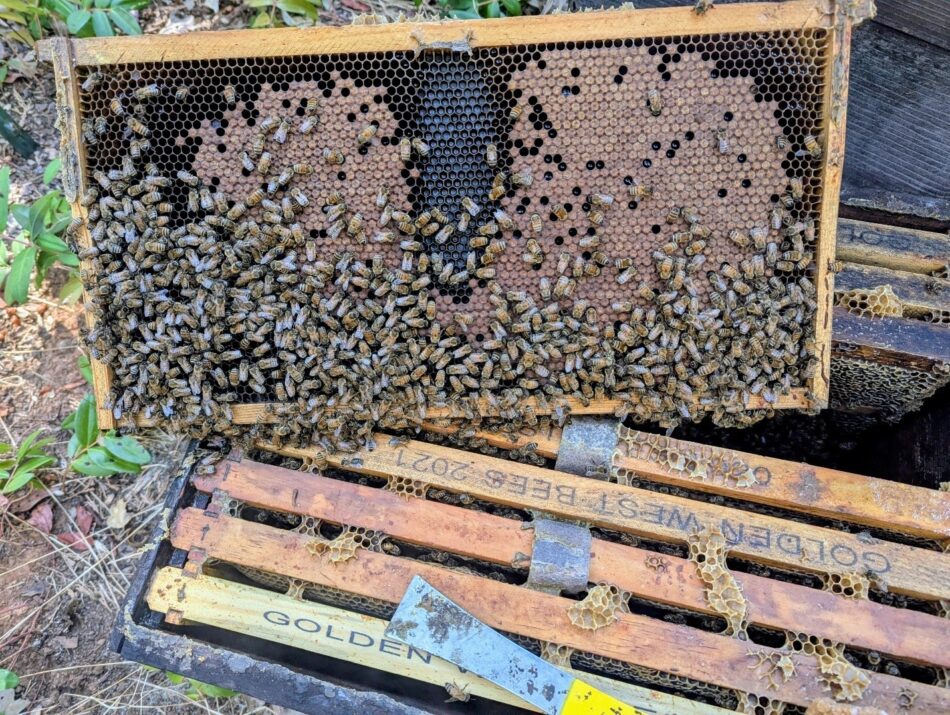
Fig. 10 When strips are inserted between the frames, there is no longer enough bee space for workers to pass through. So they generally tear down cell walls to create passage space. One possible benefit from this might be that such squeezing helps to transfer the acid onto the bees’ bodies.

Fig. 11 Note how in the hung VarroxSan strips, as the OA/glycerin solution absorbs water from humid air in the hive, that it is drawn downward by gravity, leaving the upper portion of the strip dry and free of acidity on the surface, whereas the lower portion is wet, with visible highly-acidic liquid that might easily transfer to a bees’ body (or even drip off).
Since our main interest was to track acid residues, we were disappointed by how low the titration results were during the first month (mostly zeroes), so we took mite wash counts again in early August, removed the strips and sponges, and reapplied fresh replacements to each hive. We then ran the trial for another month, taking final wash counts in early September.
EFFECT UPON THE MITE INFESTATION LEVEL
The main purpose of our trial was to track oxalic residue levels – we took mite wash counts solely to see whether there was a correlation between the two. I can’t calculate efficacy, since we didn’t have enough hives to run an untreated Control group. That said, for all the hives in which mite counts went down, we can assume that there was high efficacy. I’ve plotted out the results of the mite wash counts in Figure 12.

Fig. 12 The results were relatively consistent in that in nearly all the hives, the treatments took the mite counts down (with similar slopes of decrease, and the greatest reduction in the first month). he two plots of interest are those from hives that had their VarroxSan strips laid flat, in which the counts went up.
Analysis: I’m of course limited by the small number of hives in each test group. The greatest and most consistent reduction occurred in the 8 hung VarroxSan and Swedish sponge groups (with average reductions of 95% (indicating extremely high efficacy), with 2 of 3 hives in those groups zeroing their mite counts out. The Canadian strips were in the same ballpark (ignore the one that started with, and maintained, a count of 1)..
Of greatest interest is that, similar to both Branchiccela’s and Binnie’s trials, the laid-flat strips performed nearly as well in four out of six hives, but in this trial failed to reduce the mite counts in the other two. I cannot yet guess why, particularly since the flat sponges performed so well (we’ll see why in the next section).
Practical application: Contrary to Bob and Greg’s results (in which the average mite wash counts increased), virtually all of my extended OA treatments reduced the counts significantly. This raises the question of Why? Why do many of us worldwide get better results than did Greg or Bob? Of course the question of humidity comes to mind ―I’ll dive into that in the next installment of this series.
Did efficacy correlate with the acidity on the bees?
Thought you’d never ask! I’ll show our full results next month, but take a look at Figure 13.

Fig. 13 Surprisingly (yes, we are often surprised by our findings), there was minimal correlation between the average amount of acidity per bee over the course of the trial (titrated weekly) and the degree of mite reduction ―there were three 100% reductions at the lowest levels of acidity (go figure!). But in the two laid-flat VarroxSan hives in which mite counts increased (negative reduction), the acidity levels on the bees were very low.
Note the very low levels of acidity overall ―all averages were below 2µg per bee, compared to the 40µg levels that we measure shortly after vaporizations or dribbles (although those high initial levels quickly drop to near zero). What we’ve found is that extended-release treatments maintain a very low, but consistent, level of acidity on the bees day after day for up to a couple of months (especially with sponges). I’ll go into why this may work in an upcoming article.
Practical application: The takeaway is that (as I’ve shown in previous articles [[12]]) is that OAE (including a full dose of VarroxSan ) can be quite efficacious in California, especially when applied in absorbent matrices laid flat across the top bars. The question remains as to why we got the anomalies with the flat-laid strips (I wish that could have run 4 hung VarroxSan). We clearly need more research in humid areas to determine how to improve OAE performance under those conditions.
NEXT
Stay tuned to see what we learned about the acidity on the bees, and the effect of humidity (teaser: it can have a major effect upon VarroxSan).
Notes and Citations
[1] https://scientificbeekeeping.com/beyond-taktic/ ABJ Jan 2017
[2] Branchiccela, B, et al (2025) Oxalic acid in cellulose strips: towards an efficient and sustainable approach for the control of Varroa destructor. Apidologie 56(1): 21.
[3] You can use this spreadsheet to calculate efficacy: https://scientificbeekeeping.com/scibeeimages/Henderson-Tilton-share-version-1.xlsx
[4] Branchiccela, B, et al (2025) Oxalic acid in cellulose strips: towards an efficient and sustainable approach for the control of Varroa destructor. Apidologie 56(1): 21.
[5] https://scientificbeekeeping.com/scibeeimages/Henderson-Tilton-share-version-1.xlsx
[6] Ibid.
[7] Ibid.
[8] https://www.youtube.com/watch?v=nqy_MCn5mHY
https://www.youtube.com/watch?v=3O3meHiigW8&list=PLnIUDXjFDpxcKT8aaBwnDDksKAcBUFt5v&index=3&t=1803s
[9] https://www.youtube.com/watch?v=nqy_MCn5mHY
https://www.youtube.com/watch?v=3O3meHiigW8&list=PLnIUDXjFDpxcKT8aaBwnDDksKAcBUFt5v&index=3&t=1803s
[10] https://www.youtube.com/watch?v=sfsanU4ca_o
[11] https://www.youtube.com/watch?v=sfsanU4ca_o
[12]Oliver (2024) 2023 Field Trial of Matrices and Formulations for Extended-Release Oxalic Acid. Jan ABJ https://scientificbeekeeping.com/8466-2/