


Colony Health & Varroa
Allow me to start with an excellent assessment by Bee Culture’s Phil Craft (BC July 2015):
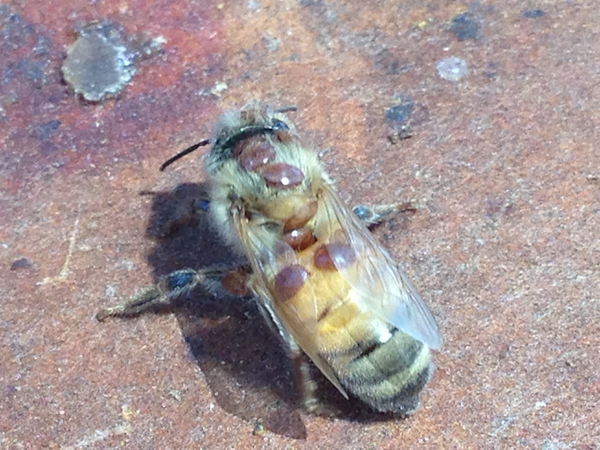
Perhaps beekeepers who have come to the craft in the last few decades aren’t aware of the effect varroa had when it first arrived on this continent and of how it earned its full name, Varroa destructor. Whatever the reason, every year, beekeepers all over the country lose colonies to mites and the viruses of which they are carriers, and they never know what hit them. They blame pesticides,or CCD, or habitat loss, and sometimes those really are causes, or at least significant factors. However, too, too often, the underlying cause is a lack of effective management, which allows a mite infestation to overwhelm a colony or weaken it to the point that it succumbs easily to other stressors. The most frustrating thing about these losses is that they don’t have to happen.
Watch Dennis vanEngelsdorp explain why mite management is critical for colony survival, and which methods work or don’t at https://www.youtube.com/watch?v=4bm3Y4t1NwQ
Oxalic Acid Dribble and Sublimation Updates
Update 28 Oct 2018 Beekeeper Nick Kingan let me know that there’s a nice livestock syringe available from Tractor Supply that can be adjusted to dispense 5 mL per squeeze. I find the squeezing of this sort of syringe to be tiring to my hand if I’m treating a large number of hives, but...
Simulation of sugar dusting against varroa
Knowing the intrinsic rate of reproduction of the honey bee colony and of varroa, the proportion of mites that are phoretic at the time, and the efficacy of a powdered sugar dusting at removing those phoretic mites, one can create a spreadsheet that will calculate the estimated effect of repeated sugar dustings. I’ve done so,...
A Test of Hopguard II As A Late-Summer Mite Treatment
A Test of Hopguard II As A Late-Summer Mite Treatment Randy Oliver ScientificBeekeeping.com First published in ABJ in December 2014 Introduction This summer my sons and I struggled with varroa in our operation; seems that we should have focused on mite control a couple of weeks earlier than usual. I kicked myself for allowing the...
Messin’ With Varroa 2014
Messin’ with Varroa Randy Oliver ScientificBeekeeping.com First Published in ABJ in Jan 2015 Some years we’re in the business of raising bees; in others we seem to merely be raising food for the varroa mite. When I returned in late November from speaking on the subject of mite management at several conferences, to my dismay...
No Negative Effect From Extended Exposure To Amitraz
No Negative Effect From Extended Exposure To Amitraz Randy Oliver ScientificBeekeeping.com First Published in ABJ in July 2015 Why are we hearing of elevated rates of queen loss and poor survivability of colonies these days? Could it have anything to do with sublethal effects of the commonly used miticide amitraz? Introduction Last spring I ran...
Mite Washer; Still Improving
Mite Washer; Still Improving Randy Oliver ScientificBeekeeping.com First Published in ABJ in August 2015 The quickest and most accurate way to monitor varroa levels is by the alcohol wash. After the publication of my “improved” washer design, I’ve gotten some great suggestions from readers. Unless you monitor for varroa, you have no idea as to...
Oxalic acid Powerpoint presentation
Updated 15 January 2016 Updated oxalic acid ppt presentation Since the EPA registered oxalic acid for the use in beehives (as far as I know, Brushy Mountain has the only registered product to date), I’ve been flooded with questions about using it (since I’ve used it steadily in my operation for over a decade). Therefore,...
Other resources on varroa management
There are a number of other resources for reliable information on varroa management, some of which I’ll include links for: The Honey Bee Health Coalition released this summary of mite management tools in 2015. Free download at Tools for Varroa Management
Understanding Colony Buildup and Decline: Part 10- Summer Downsizing and Varroa
Understanding Colony Buildup and Decline: Part 10 Summer Downsizing And Varroa Randy Oliver ScientificBeekeeping.com First Published in ABJ in March 2016 At this point in time, the desperate intensity of spring buildup has long since passed, swarming season is over, and the colony has had its chance to use the main honey flow to put...
Understanding Colony Buildup and Decline: Part 11 – Varroa and Late Season Collapse
Understanding Colony Buildup and Decline: Part 11 Varroa and Late Season Collapse Randy Oliver ScientificBeekeeping.com First Published in ABJ in April 2016 I’m writing this article shortly after moving my hives to almond pollination. The supply of strong, healthy hives was short this season, but that came as no surprise. I’d heard reports from all...
A Test of Late-Summer Varroa Treatments
A Test of Late-Summer Varroa Treatments Randy Oliver ScientificBeekeeping.com First published in ABJ June 2016 Last summer, deep in extended drought, we California beekeepers struggled with varroa. And I realized that I had long been using (and recommending) a mite treatment application based upon hearsay rather than actual data—shame on me! By trial and error,...
The Varroa Problem: Part 1
The Varroa Problem: Part 1 Randy Oliver ScientificBeekeeping.com First Published in ABJ in November 2016 Legend has it that King Sisyphus was condemned to the maddening task of being forced each day to roll a huge boulder to the top of a hill, only to watch it roll back down again, and then to repeat...
The Varroa Problem: Part 2 – The Coevolution of the Bee, Varroa and DWV
The Varroa Problem: Part 2 The Coevolution of the Bee, Varroa, and DWV Randy Oliver ScientificBeekeeping.com First Published in ABJ in Dec 2016 In order to solve The Varroa Problem, we need to understand the biology of how it was created, and what perpetuates it. A Time To Work Together I’m a strong proponent of...
The Varroa Problem: Part 3 – A Creation of Our Own Doing
The Varroa Problem: Part 3 A Creation of Our Own Doing Randy Oliver ScientificBeekeeping.com First published in ABJ in Dec 2016 The Varroa Problem didn’t just happen—we created it, and we unintentionally perpetuate it. And we will continue to prolong the agony until we, as a community, finally say “Enough!” and start to work...
The Varroa Problem: Part 4 – Mite-Resistant Bees- Pipe Dream or Plausible?
The Varroa Problem: Part 4 Mite-Resistant Bees—Pipedream or Plausible? Randy Oliver ScientificBeekeeping.com First published in ABJ January 2017 I imagine that some readers may be thinking, “Randy lives in cannabis country with the rest of the fruits and nuts in California—what’s he been putting into his smoker?” And I’m glad to hear that, since smart...
ScientificBeekeeping is a not-for-profit enterprise, and I’m happy to receive notes of thanks for how information on this site has contributed to my readers’ success at beekeeping (and sometimes saved them hundreds or thousands of dollars). It is your support that allows me to devote my life to this site. All donations go towards website maintenance, bee research costs (typically tens of thousands of dollars per year), re-donations to fund research by others, and a small amount to partially offset the huge number of hours that I spend in research and writing. I guarantee that every penny is pinched and well spent!
Your donations not only support our own research; we redirect a substantial proportion of donations to Scientific Beekeeping to organizations who we see making the most impact towards helping pollinators – notably those who work with farmers and landowners, or preserve critical habitat.
I appreciate the notes of support that I receive from all over the world. Seeing who is donating, their locations, and the little notes that come with contributions help to let me know how I should direct my research and writing. In appreciation, and in order to show who is supporting my research and writing, I honor below those who have recently made substantial donations:
REGULAR SERIOUS DONORS
Tracy Fasanella
Brandon Hertel
* Homestead in the Hood, Colorado
DaleLesser, Michigan
Conway Veterinary Hospital
Matthew McLean, Colorado
Jim & Paulette Lynn, Iowa
Karen Barnhart, Iowa
Jean Knudsen
Yumei Xiong
Thomas Kirwan
Andrew Dewey, Maine
Madeline Mead
Jill Lambie-ponce
RECENT MAJOR SUPPORTERS
John Gaut
James Jakim, Pennsylvania
Los Angeles County Beekeepers
Justin Ray
Alameda County Beekeepers Association, CA
Santa Clara Valley Beekeepers Guild, CA
Ihor Skrypka
Mike Tooley
Chatham County Beekeepers Association
Darren Tressider
Charles Clark
Victorian Apiarists’ Association
Peter Krey
Chrisensen Family Apiaries, Michigan
Nebraska Beekeepers Assoc.
Hiatt Honey LLC
Miller Honey Farms, California
Paul Hosticka, Washington
Tualatin Valley Beekeepers Association, Oregon
Merrimack Valley Beekeepers, NH
Colorado State Beekeepers Assoc.
Alameda County Beekeepers Assoc, Calif
New Mexico Beekeepers Assoc
Colonial Beekeepers Assoc, Virginia
Help Save the Bees Foundation, Nevada
James Jakim, Pennsylvania
RECENT $100+ SERIOUS SUPPORTERS
Rick Hyde
Mohawk Valley Trading Company
Ron Morrison
Susan Ament
Richard Reid
San Mateo Bee Guild, California
Zach Suddaby
Cara Ching, California
Vincent Aloyo, Pennsylvania
Rick Anderson, Kansas
Perry County Beekeepers Club
Lawrence Huba
Charles Reichert
Charles Clark
Charlean Andes
Always Summer Herbs, Florida
Bill Hall
David George
Dean Christie
Roy Manicke
Jersey Cape Beekeepers Association
Kansas Honey Producers Association
New Hampshire Beekeepers Association
Chester County Beekeepers Assoc, Pennsylvania
Debbie Hewitt, Maryland
Mile Hive Bee Club, Colorado
Dale Lesser, Minnesota
Santa Clara Valley Beekeepers Guild, California
Stevan Huffman, Alaska
Flower Street Farm
Cara Ching, California
Terry Barrett
Robert M Simonson
Vincent Aloyo, Pennsyvania
Byron Godard
Southern Oregon Beekeepers Association
Lawrence Chismar
Middlesex Beekeepers Association, Massachusetts
Montgomery County Beekeepers, Maryland
Charles Clarke, California
Andrew Dewey
Ralph Carter, California
Barnstable County Beekeepers Association
Mary Aho
Sonja Percival
New York Bee Wellness
Liz and Terry Huxter
David Ball
Paul W. Garges
Andrew Levi
Jim Veitch, California
Mark Simonitsch, Massachusetts
Kenneth Sallitt
Kelle Frymire
Tamiko Panzella, California
Rodd Hall, Wisconsin
James Baerwald
Jean Knudsen
Yosef Shochat, Israel
Nicolas Geant
Charles Clark
Merrimack Valley Beekeepers
Michael Cummings
Bryce Lord
Jersey Cape Beekeepers
Busy Bee Honey, Vermont
Rick Anderson
Steve Sweet, Idaho
Ulster County Beekeepers Association
Jan Lawson
Honey Bee Club of Stillwater, Minnesota
Black Hills Area Beekeeping Club, South Dakota
Richard Ozero, Alberta
Paul Yanus, Vermont
Suddabees Honey LLC
Dean Christie
New Hampshire Beekeepers Association
Jane Sebring
Vincent Aloyo
Connecticut Beekeepers Association
Jim Lyssy
Wyoming Beekeepers Association
Tualatin Valley Beekeepers, Oregon
Yosef Shochat
Dale Lesser
Jill Lambie-ponce
Deborah Corcoran
Justin Ray
Idaho Honey Producers Association
Capital Area Beekeepers Association, PA
Mark Simonitsch, MA
Central Maryland Beekeepers Association
Roy Manicke
Kansas Honey Producers Association
Charles Bailey Jr
Richard Reed
Gregory Quinn
John Allison
Joshua Sewell
Chris Abbot, Virginia
Owyhee Honey Company
Idaho Honey Ranch
Mount Diablo Beekeepers Association, California
Charles Bailey Jr
Raritan Valley Beekeepers Association
Mike Tooley
Los Angeles County Beekeepers Association
Santa Clara Valley Beekeepers Guild
Pamela Stegemerten
Vermont Beekeepers Association
Los Angeles County Beekeepers Association
Michael Kurtz
Dan Geer
Ross Honey Company
Steven Greenwood
Julie Spezia
Stephen Lamb, California
Pam Rogers, Indiana
El Dorado Beekeepers, California
Bill Mares, Vermont
Mike Stoops
Adam Bagerski, Oregon
Dorothy Hammett
Janine Cohen, California
Neil Nordquist, California
Richard Hyde, California
Bonnie Bee & Co., California
Merrimack Valley Beekeepers Association, New Hampshire
Laura Risk, Colorado
Capital Area Beekeepers Association, Pennsylvania
West Sound Beekeepers Association, Washington
Beekeepers’ Guild San Mateo, California
Omaha Bee Club, Nebraska
Joplin Area Beekeepers Association
Steve Sweet, Idaho
Bill’s Bees
Rich Blohm, New York
James Baerwald
Kip Glass, Missouri
Charles Vorisek
Carlos Perez, California
Debra Morey
Margaret Varney
Chester County Beekeepers Association, Pennsylvania
Thomas Dahl
Vince Aloyo, Pennsylvania
Charles Bureau
Help Save the Bees Foundation, Nevada
Aaron Bergman, Florida
Alan Herzfeld, Idaho
Eli’s Bees, California
Ghislain De Roeck, Belgium
Buncombe County Beekeepers, North Carolina
Robert Holcombe, Rhode Island
Alex Naumenko, Florida
Honey Bee Club of Stillwater, Minnesota
New Hampshire Beekeepers Association
Merrimack Valley Beekeepers, New Hampshire
Blossomwood Honey, Al
Bee Thankful Raw Honey
Skip Smith
Jean Knudsen
Jason Hough, Maryland
Tualatin Valley Beekeepers, Oregon
Craig Falls, New York
Michael Aaby, Maryland
Keith Scott
Randall Carter, Alabama
Thomas Kirwan
Nicolas Geant, California
Lee Bussy
Jean Knudsen
Andrew Dewey, Maine
Jason Wester, Michigan
Everything on this website is open access and freely given to beekeepers and researchers worldwide, on a not-for-profit basis. I gladly accept supportive personal gifts of appreciation from my readers. You can donate via Paypal below (or better yet via Venmo as a gift to @RandyOliverBeekeeper). I will treat all Paypal donations as “gifted grants to be applied towards beekeeping research” given by you with “detached and disinterested generosity out of affection, respect, admiration, charity or like impulses,” and not in the expectation of any goods or services. Since I am not a 501(c)(3), your gifts are not tax deductible.
Thank you and happy beekeeping!
Randy
Supporters
ScientificBeekeeping is a not-for-profit enterprise, and I’m happy to receive notes of thanks for how information on this site has contributed to my readers’ success at beekeeping (and sometimes saved them hundreds or thousands of dollars). It is your support that allows me to devote my life to this site. All donations go towards website maintenance, bee research costs (typically tens of thousands of dollars per year), re-donations to fund research by others, and a small amount to partially offset the huge number of hours that I spend in research and writing. I guarantee that every penny is pinched and well spent!
I appreciate the notes of support that I receive from all over the world. Seeing who is donating, their locations, and the little notes that come with contributions help to let me know how I should direct my research and writing. In appreciation, and in order to show who is supporting my research and writing, I honor below those who have recently made substantial donations:
REGULAR SERIOUS DONORS
Tracy Fasanella
Brandon Hertel
* Homestead in the Hood, Colorado
DaleLesser, Michigan
Conway Veterinary Hospital
Matthew McLean, Colorado
Jim & Paulette Lynn, Iowa
Jean Knudsen
Yumei Xiong
Thomas Kirwan
Madeline Mead
Jill Lambie-ponce
RECENT MAJOR SUPPORTERS
Tualatin Valley Beekeepers, Oregon
Denis Watts
Kebin Duesman
James Jakim, Pennsylvania
Los Angeles County Beekeepers
Justin Ray
Alameda County Beekeepers Association, CA
Santa Clara Valley Beekeepers Guild, CA
Ihor Skrypka
Mike Tooley
Chatham County Beekeepers Association
Darren Tressider
Charles Clark
Victorian Apiarists’ Association
Peter Krey
Chrisensen Family Apiaries, Michigan
Nebraska Beekeepers Assoc.
Hiatt Honey LLC
Miller Honey Farms, California
Paul Hosticka, Washington
Tualatin Valley Beekeepers Association, Oregon
Merrimack Valley Beekeepers, NH
Colorado State Beekeepers Assoc.
Alameda County Beekeepers Assoc, Calif
New Mexico Beekeepers Assoc
Colonial Beekeepers Assoc, Virginia
Help Save the Bees Foundation, Nevada
James Jakim, Pennsylvania
RECENT $100+ SERIOUS SUPPORTERS
Rick Hyde
Ron Morrison
Susan Ament
Richard Reid
San Mateo Bee Guild, California
Zach Suddaby
Cara Ching, California
Vincent Aloyo, Pennsylvania
Rick Anderson, Kansas
Perry County Beekeepers Club
Lawrence Huba
Charles Reichert
Charles Clark
Charlean Andes
Always Summer Herbs, Florida
Bill Hall
David George
Dean Christie
Roy Manicke
Jersey Cape Beekeepers Association
Kansas Honey Producers Association
New Hampshire Beekeepers Association
Chester County Beekeepers Assoc, Pennsylvania
Debbie Hewitt, Maryland
Mile Hive Bee Club, Colorado
Dale Lesser, Minnesota
Santa Clara Valley Beekeepers Guild, California
Stevan Huffman, Alaska
Flower Street Farm
Cara Ching, California
Terry Barrett
Robert M Simonson
Vincent Aloyo, Pennsyvania
Byron Godard
Southern Oregon Beekeepers Association
Lawrence Chismar
Middlesex Beekeepers Association, Massachusetts
Montgomery County Beekeepers, Maryland
Charles Clarke, California
Andrew Dewey
Ralph Carter, California
Barnstable County Beekeepers Association
Mary Aho
Sonja Percival
New York Bee Wellness
Liz and Terry Huxter
David Ball
Paul W. Garges
Andrew Levi
Jim Veitch, California
Mark Simonitsch, Massachusetts
Kenneth Sallitt
Kelle Frymire
Tamiko Panzella, California
Rodd Hall, Wisconsin
James Baerwald
Jean Knudsen
Yosef Shochat, Israel
Nicolas Geant
Charles Clark
Merrimack Valley Beekeepers
Michael Cummings
Bryce Lord
Jersey Cape Beekeepers
Busy Bee Honey, Vermont
Rick Anderson
Steve Sweet, Idaho
Ulster County Beekeepers Association
Jan Lawson
Honey Bee Club of Stillwater, Minnesota
Black Hills Area Beekeeping Club, South Dakota
Richard Ozero, Alberta
Paul Yanus, Vermont
Suddabees Honey LLC
Dean Christie
New Hampshire Beekeepers Association
Jane Sebring
Vincent Aloyo
Connecticut Beekeepers Association
Jim Lyssy
Wyoming Beekeepers Association
Tualatin Valley Beekeepers, Oregon
Yosef Shochat
Dale Lesser
Jill Lambie-ponce
Deborah Corcoran
Justin Ray
Idaho Honey Producers Association
Capital Area Beekeepers Association, PA
Mark Simonitsch, MA
Central Maryland Beekeepers Association
Roy Manicke
Kansas Honey Producers Association
Charles Bailey Jr
Richard Reed
Gregory Quinn
John Allison
Joshua Sewell
Chris Abbot, Virginia
Owyhee Honey Company
Idaho Honey Ranch
Mount Diablo Beekeepers Association, California
Charles Bailey Jr
Raritan Valley Beekeepers Association
Mike Tooley
Los Angeles County Beekeepers Association
Santa Clara Valley Beekeepers Guild
Pamela Stegemerten
Vermont Beekeepers Association
Los Angeles County Beekeepers Association
Michael Kurtz
Dan Geer
Ross Honey Company
Steven Greenwood
Julie Spezia
Stephen Lamb, California
Pam Rogers, Indiana
El Dorado Beekeepers, California
Bill Mares, Vermont
Mike Stoops
Adam Bagerski, Oregon
Dorothy Hammett
Janine Cohen, California
Neil Nordquist, California
Richard Hyde, California
Bonnie Bee & Co., California
Merrimack Valley Beekeepers Association, New Hampshire
Laura Risk, Colorado
Capital Area Beekeepers Association, Pennsylvania
West Sound Beekeepers Association, Washington
Beekeepers’ Guild San Mateo, California
Omaha Bee Club, Nebraska
Joplin Area Beekeepers Association
Steve Sweet, Idaho
Bill’s Bees
Rich Blohm, New York
James Baerwald
Kip Glass, Missouri
Charles Vorisek
Carlos Perez, California
Debra Morey
Margaret Varney
Chester County Beekeepers Association, Pennsylvania
Thomas Dahl
Vince Aloyo, Pennsylvania
Charles Bureau
Help Save the Bees Foundation, Nevada
Aaron Bergman, Florida
Alan Herzfeld, Idaho
Eli’s Bees, California
Ghislain De Roeck, Belgium
Buncombe County Beekeepers, North Carolina
Robert Holcombe, Rhode Island
Alex Naumenko, Florida
Honey Bee Club of Stillwater, Minnesota
New Hampshire Beekeepers Association
Merrimack Valley Beekeepers, New Hampshire
Blossomwood Honey, Al
Bee Thankful Raw Honey
Skip Smith
Jean Knudsen
Jason Hough, Maryland
Tualatin Valley Beekeepers, Oregon
Craig Falls, New York
Michael Aaby, Maryland
Keith Scott
Randall Carter, Alabama
Thomas Kirwan
Nicolas Geant, California
Lee Bussy
Jean Knudsen
Andrew Dewey, Maine
Jason Wester, MIchigan


Thanks to these sponsors, you can enjoy this website without annoying popup ads!
You can show your appreciation by clicking on their banners above to go directly to their websites.